Wednesday, November 21, 2012

The Destructive Power Of Alcohol


Abu Darda(ra) narrated that the Messenger of Allah (saws) said: Don't drink wine for it is the key to every evil.

[Al-Tirmidhi]

Explanation: Alcohol has been the scourge of human society since time immemorial. It continues to cost countless human lives, and inflicts terrible misery to millions throughout the world. Alcohol is the root cause of several problems facing society. The statistics of soaring crime rates, increasing instances of mental illnesses & millions of broken homes throughout the world bear mute testimony to the destructive power of alcohol.

The 'good' in wine is popularly known as a certain taste & a feeling of well-being, professed increase of temporary energy, and a given glow on the face. Being transient, these benefits hardly stand against the array of evils that drinking breeds.

Let's take the human body first. Drinking causes mal-function of the stomach, reduces desire to eat, affects facial contours, inflates the waistline, hurts the livers and the kidneys and becomes a contributor to all sorts of diseases. Reason does not work under the influence of hard drinks and one cannot manage things until one becomes sober after sometime. The hangover turns out to be as bad. The morning after a party is hard for a drinker who gets a splitting headache & is disoriented after his late-night bout of drinking.

Wine, a tempting stimulant and a much romanticized poison works slowly, inspite of the spirited defense put up by its users. The fact is that drinking not only harms the elders but also effects their born or yet to come children as well. So. the habit of drinking is not only evil in itself but a mother of other evils too making men ready to commit the worst possible crimes against their fellow beings.

Monday, November 19, 2012

Adopt the Sunnah


Hazrat Anas (ra) reports that Rasoolullah (saws) advised "Whoever cherishes my Sunnah, indeed he cherishes me and whoever loves me will be with me in Jannah."

[Tirmidhi]

Explanation: As Muslims, it's our belief that every Sunnah of our beloved Nabi (saws) is filled with blessings of Allah Ta'ala. It was for this reason that Allah (Swt) granted the Shaabah (rd) and Muhadditheen capabilities required to preserve the Sunnah. Alhamdulillah a large amount of authentic literature is available in which the blessed Sunnah of Rasoolullah (saws) is preserved to this day for the follower to adopt and implement in his life.

In another hadith, Rasoolullah (saws) said, "He who holds firm to my Sunnah when corruption is rampant in my Ummah will attain the reward of a hundred martyrs." [Al-Bayhaqi]

The Sunnah of Rasoolullah (saws) is not restricted to acts or places of worship only. Instead, it is comprehensive and covers all aspects and situations of life such as one's social and moral conduct, business dealings, his dressing etc. It also applies to all places whether the Masjid, business place, the home or even while one is on a journey to any far off land. In every situation, one must draw guidance from the lifestyle of Rasoolullah (saws) thereby turning everyday habits into acts of worship.

Monday, September 17, 2012

Enjoin Good and Forbid Evil


"And there has to be a group of people from among you who call towards the Good and and bid the Fair and forbid the Unfair . And it is these who are Successful "

[Qur'an , Surah Al-Imran, Verse 104]

Explanation : It is has been said here that Muslims are not to rest at the correction of what they think and do individually, but they should along with that, be affectionately concerned with the good of other brothers and sisters in faith.

By doing so, the whole community shall have the benefit of keeping its stance correct at all times, and at the same time this will guarantee closer mutual cooperation and unity.

Collective well-being of Muslims depends on two things :
1. Self-correction through Taqwa and a firm hold on the cord of Allah through Qur'an and Sunnah
2. The correction of others through Da'wah and positive propogation.

This subject appears in Surat ul-Asr "Except those who believe and do good deeds and invite each other to truth and invite each other to patience." (103: 2-3)

Hence, one must correct his or her deeds and morals in the Light of what Almighty Allah has sent as the Law and with it , one must be concerened that other Muslim brothers and sisters do the same.

In order that Muslims have a firm bond of unity, they must relate to Allah , and in order that this bond stays firm throgh the ages, it is necessary that Muslims consider their obligation to enjoin what is good and in accordance with the dictates of the Qur'an and Sunnah on their brothers and sisters in faith, and stop them from what is not good.

Thursday, September 13, 2012

A Sign Of Perfection Of Worship


It is stated by Hazrat Thauban (ra) that when the Messenger of Allah (saws) finished offering his prayers, he sought forgiveness of Allah three times

[Muslim]

Explanation : This hadith tells us that after the Prophet (saws) would say "Astagfirullah" three times.  In fact, it is a sign of perfection of worship that a man having offered prayers considers his eforts imperfect and regards himself responsible for that.So, he seeks the forgiveness of Allah.

Taubah (repentance) and Istighfaar (seeking forgiveness from Allah) are among the most meritorious acts of virtue for the believers. Taubah means feeling remorse for our actions or omissions.Istighfar means expressing that remorse in words and begging Allah for forgiveness. The act for which we perform taubah and istighfar is not necessarly a sin or an act of disobedienceto Allah, it also includes our shortcomings.

As we realise Allah's immense favours to us, all our thankfulness and devotion clearly appears to be inadequate.As we realise the Grandeur of Allah, Most High, our acts of worship and obedience are clearly seen to be insufficient.

The higher a person is on the scale of piety and taqwa, the greater is this sense of inadequacy. Consequently the greater is his practice of Istighfar.


Thursday, July 19, 2012

Blessings of Ramadan


Narrated Abu Huraitah (ra) : I heard Allah's Apostle (saws) saying regarding Ramadan "Anyone who stands in prayers during its nights (in Ramadan) with purity of belief and expectation of a reward, will have his previous sins forgiven."

[Bukahri]

Explanation: Once again the holy month of Ramadan has returned with all its blessings. It has come with the message of salvation and forgiveness

During Ramadan the believers get busy seeking Allah’s mercy, forgiveness, and protection from Hellfire. This is the month for renewing our commitment and re-establishing our relationship with our Creator. It is the spring season for goodness and virtues when righteousness blossoms throughout the Muslim communities.

 It offers every Muslim an opportunity to strengthen his Iman, purify his heart and soul, and to remove the evil effects of the sins committed by him.

In addition to fasting, mandatory Salat, and extra Taravih Salat, Muslims should spend the whole month in acts of worship like voluntary Salat, Tilawah (recitation of Qur’an), Dhikr , Charity, Itikaf etc.

Allah increases the reward for deeds in this special month. For an optional (nafl) act, a person is rewarded according to the reward of a mandatory (fard) deed, and the reward for a fard is multiplied at least seventy times.

The first ten days of Ramadan are days of mercy; the second period of ten days is for forgiveness, and the final period of ten days is for seeking refuge from Hellfire.

Every Muslim should cut all negative ties with society at least for this month and view it as the month of working diligently on oneself. This is the month of earning and we should work hard to earn reward and righteousness.

Ramadan is the month for rebuilding our spiritual strength. How much we benefit from it is up to us..

Monday, July 16, 2012

Reasons For Fasting in Ramadan

O ye who believe! Fasting is ordained for you, even as it was ordained for those before you, that ye may guard yourself (against evil)”

[The Holy Qur’an: Chapter 2, Verse 183]

Explanation : Ramadan is a month of fasting and prayers for the Muslims. The fast consists of total abstinence from food and drink from dawn to dusk. There is, however, a greater significance to fasts than mere abstinence from eating and drinking. The real objective of fasts is to inculcate in man the spirit of abstinence from sins and of cultivation of virtue. Thus the Qur’an declares that the fasts have been prescribed with a view to developing piety in man, as is clear from the verse quoted above.

How are the many facets of piety sought to be cultivated through the fasts?

1.The prime consideration in undertaking fast, as in any act of devotion, is to seek NEARNESS TO GOD and beseech HIS PLEASURE and FORGIVENESS. This itself generates a spirit of piety in man.

2.The wilful creation of the stringent conditions of hunger and thirst for one’s own self, simply in obedience to the Divine Order, measures the FAITH of man in God and helps to strengthen it by putting it to a severe test.

3.Fasting enhances through creation of artificial non-availability, the value of the bounties of God, which man is apt to take for granted in the midst of plentiful availability, and thus inculcates in man a spirit of GRATITUDE and consequent DEVOTION to GOD. Nothing else can bring home to man the worth of God’s bounties than a glass of water and a square meal after a day‑long fast. This also reminds man that the real joy in enjoying God’s bounties lies in MODERATION and RESTRAINT and not in OVER INDULGENCE.

4. Fasting makes us deeply conscious of the pangs of hunger and discomfort suffered by the less fortunate among our brethren, who may have to put up with such stringent conditions all through their lives ‑ it thus enkindles in man a spirit of SACRIFICE leading to CHARITY towards his suffering brethren.

5. Fasting affords man an unfailing training in ENDURANCE ‑ i.e. a SPIRIT OF. ACCEPTANCE of the inevitable, which could well prepare him to put up with the unchangeable situations in life in the same spirit of RESIGNATION as cultivated during the fasts.

6. Fasting develops COURAGE, FORTITUDE and a FIGHTING SPIRIT IN man to surmount the heavy odds in life with a cool and tranquil mind. It sharpens his, power of CONCENTRATION to overcome obstacles, through a vigorous exercise all through the month, leading to a steeling of his WILL POWER and RESOLVE, which could help him in trying situations in actual life. It is seen that many an undesirable habit which is found hard to leave, is more easily left off during the days of fasting.

7. Fasting teaches man RELIANCE on God and CONFIDENCE in HIM in facing the bitter situations in life with the comforting thought that these too, ordained by Him, could well be surmounted through His assistance alone, even as the rigorous state of fasting for a complete month. For, fasting develops the quality of PATIENCE in man, with the realisation that, as the days of fasting, though seeming unending do have a successful and, so are all the bitter situations in life. It therefore infuses a spirit of GOOD CHEER, (driving away BITTERNESS and DESPAIR) in his attitude towards life and in his demeanour towards others.

8. Through quick alternation of the state of plenty and of scarcity, fasting seeks to inculcate in man the right type of attitude in different situations in life‑ of GRATITUDE and THANKSGIVING in plenty and of PATIENCE and FORBEARANCE in difficulty.

9. Fasting is meant to CONQUER ANGER, not to augment it, and to develop SELF‑CONTROL in man; for the vigorous effort of wilfully putting up with a continued state of hunger and thirst can well be extended to conquer other infirmities of human character that lead man into error and sin.

10. Fasting inculcates a spirit of TOLERANCE in man to face unpleasant conditions and situations without making his fellow-being the victim of his wrath on account of his adverse conditions, such as deprivation of his basic needs of life, which constitutes the common cause of dissension among men.

11. Fasting MELLOWS a man and enhances his character, giving jolt to the human instincts of ‘PRIDE, HAUGHTINESS, ENVY and AMBITION, for when fasting, a man’s energies are too sapped to follow these instincts which are the chief causes of discord and conflict among men.

12. Fasting exposes the weakness of man in the event of his being deprived of but two of the bounties of God ‑ those of food and drink; it thus infuses in him a spirit of MEEKNESS and SUBMISSION,
generating HUMILITY and PRAYER in an otherwise arrogant man.

13. Fasting breathes the spirit of FORGIVENESS in man towards his subordinates, as he himself seeks God’s FORGIVENESS through fasts and prayers.

14. Fasting affords lessons in PUNCTUALITY through man’s strict adherence to various time‑schedules in the observance of fasts and offering of prayers.

15. Fasting can be made to effect ECONOMY in an individual’s life, which can be extended to wider spheres.

16. Fasting enforces in man rigid DISCIPLINE ‑ mental, spiritual and physical ‑ a trait of character which forms an essential ingredient to success in human life.

17. Fasting provides LEISURE, that could he gainfully employed in devotional or intellectual pursuits. The month‑long duration of fasts creates a proper climate for the SPIRITUAL REFORMATION in man, infusing in him a spirit pf enthusiasm and zest to turn over a new leaf ‑ an opportunity provided every year.

18. On the physical side, fasting cleanses the human system of the accumulated impurities of uninterrupted eating throughout the year. It prepares the body for toughness and hardihood to face disease or conditions of scarcity. The rigid abstinence that the fast provides, regulates man’s HEALTH, sharpens has INTELLECT, gives spurt to his SPIRITUALLY and enhances the qualities of his HEART. With the cleansing of the human body, it paves the way for its easy and effective rebuilding through meals at the end of the day or after the month is over.

Monday, July 9, 2012

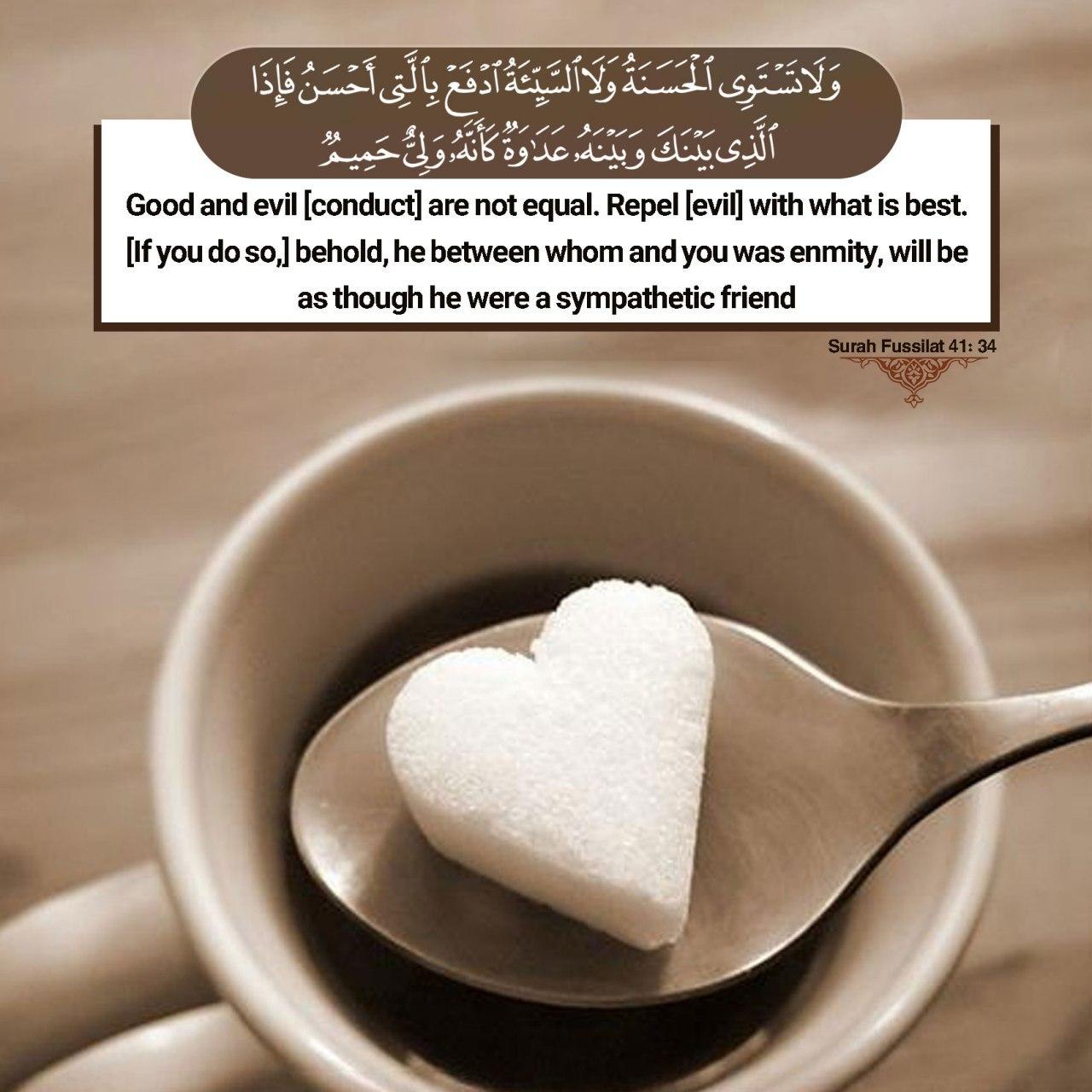
Repel Evil With Good...


The Holy Qur'an states : "Repel evil with what is best, then the one, between whom and you there is enmity, shall become as if he was a fast friend."

(41:34)

Explanation: The Holy Qur'an teaches the great moral of doing good to those who do evil and establishes how enemies turn into friends through this noble method.

This was the supreme measure of the moral training given to His noble Messenger by Allah Almighty. The guideline given to him was:

Join with him who severs relations with you and forgive him who does injustice to you and do good to him who is bad to you.

The moral grandeur of the Holy Prophet, may the peace and bless­ings of Allah be upon him, is unique and eminent. We can only think of the blessing of his teachings which so successfully ingrained even in his servants morals and traits of character similar to his own.

Being the distinctive feature of a true Islamic society, there are hundreds and thousands of models visible in the lives of the Companions, their successors and among the venerated elders of the Muslim community.

There is an apt incident in the life of the great Imam Abu Hanifah rahimahullah. Someone accosted him in a busy market place and heaped all sorts of insults and invectives on him. The great Imam controlled his anger and said nothing to him. He went home, took out a considerable quantity of gold and silver coins, put them in a gift-wrapped tray and went out to the home of his confronter. He knocked at his door. When this person came out, he presented this tray full of coins before him saying: 'Today, you did something very good to me. You gave me (something) of your good deeds (that you had done). It is in gratitude of this great favour of yours that I am presenting this gift to you.'

The Imam's unusual conduct naturally affected the man. He repented and got rid of his bad habit for ever. After asking for Imam's forgiveness, he entered into his circle as a disciple and finally became a great scholar.