Sunday, July 20, 2014

Sins....Part 2


51. To look right and left through the corners of the eyes while offering Salah.

52. To play with clothes while offering Salaah.

53. To jump ahead the lines by crossing upon the necks of the people on Jumuah (Friday).

54. To commit adultery(zina) or make anyone do it.

55. To use the back-side for intercourse or make anyone use the back-side (against the natural one) for intercourse.

56. To consume any from of alcohol.

57. To drink toddy or hemp.

58. To eat or drink anything like opium which affects the senses.

59. To do any sort of stealing.

60. To put blame on a pious woman.

61. To confiscate anyone's property in a wrong manner.

62. To use(take) any sort of interest.

63. To run away from the field of Jihad inspite of having the power to face the combat

64. To confiscate the property of an orphan.

65. To accept or give bribes to get any work done.

66. To disobey parents.

67. Not to offer the rights of the relatives.

68. To denote any tale or work wrongly or falsely towards the Prophet (peace be upon him).

69. To break the fast of Ramadhan without a genuine reason.

70. Not to observe the fast of Ramadhan without valid reasons like travelling or sickness.

71. To offer any Salah before or after its usual time.

72. To pay Zakat late without any genuine reason.

73. To die without performing Haj or without making its will though having the capacity for it.

74. To harm anyone by ill-treatment or cruelty.

75. To blame any Sahaaba radiyallahu anhum ( companions of the Prophet - peace be upon him)

76. To say bad to Hafiz-e-Quran or Ulema-e -kram.

77. To disgrace the learned (Ulema) or Hafiz -e-Quran.

78. To flatter anyone excessively or to make wrong report about anyone and hurt him.

79. To use one's own wife for committing adultery with others.

80. To use one's own sister or daughter for comitting adultery(zina) with others.

81. To become happy on the deeds of adultery committed by one's own sister or daughter.

82. To be an agent of a woman for her committing adultery.

83. Not to cast inspiration among people inspite of having power to do good things.

84. To learn magic or train in the techniques of magic.

85. To use or make anyone use magic.

86. Not to stop people from doing wrong things inspite of having the power to do so.

87. To forget the Holy Qur'an due to carelessness.

88. To stop a woman from meeting or going to her husband.

89. To stop a woman from fulfilling her husband's rights.

90. To criticise a Muslim or a non-Muslim.

91. To become nervous of Allah's kindness (rahmath).

92. To become fearless of Allah's punishment (azaab).

93. To eat meat of a dead animal without helplessness.

94. To eat meat of a pig.

95. To play or take part in any sort of gambling.

96. To spend extravagantly or more than necessary.

97. To spread riots on the land.

98. To treat one's wife as a mother, sister or daughter.

99. To do looting on the paths.

100. To be engaged often in any little sin or crime.

Saturday, July 19, 2014

Sins....Part 1


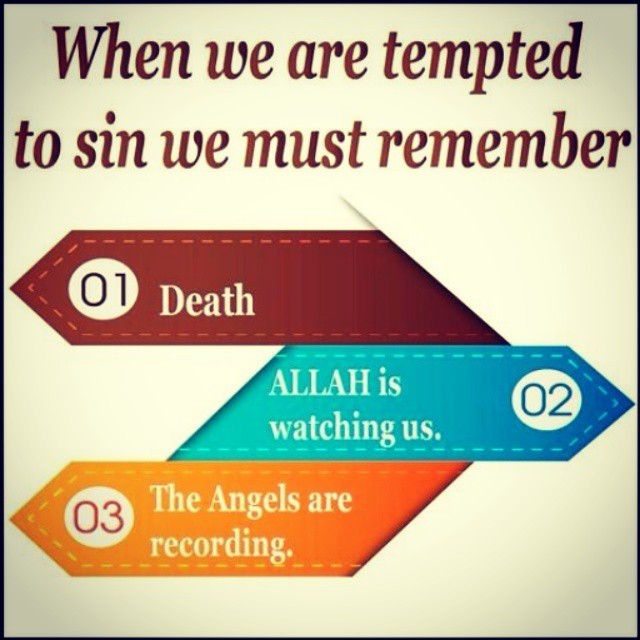
We should keep ourselves away from sins so that we remain safe from Allah's punishment in this world (duniya) and in the life after death (aakhirah). Some of the sins are mentioned below.

1. The deeds done only for worldly matters without considering the benefits of the life after death (aakhirah)

2. The talks not concerning with duniya and aakhirah.

3. To mock and irritate someone.

4. To imitate someone's walking style

5. To imitate anyone's laugh, sitting and standing positions.

6. To point out any Muslim's weakness by the sign of hand, foot or eye.

7. To seek anyone's weaknesses and faults.

8. To criticise someone/anyone.

9. To disgrace or make fun of anyone.

10. To listen to anyone's talks unnoticed.

11. To enter anyone's house without permission.

12. To peep in anyone's house.

13. To taunt or criticise anyone due to his nationality/race.

14. To count oneself in the race of others instead of one's own race.

15. To use slang language and to indulge in shameless chats.

16. To curse any person or animal.

17. To indulge in back-biting, tale-bearing or slandering.

18. To call anyone using bad names or surnames.

19. To refer or mention anyone with bad name/surname.

20. To disrespect /ill-treat the Ulemas(learned scholars) and Auliyas (saints).

21. To disrespect the verses (aayats) of Quran and Hadiths.

22. To disrespect the names of Allah Almighty .

23. To throw rubbish & garbage near the sitting or meeting places of people or on the pathways of use

24. To open one's own 'satr' without need.

25. Not to protect oneself from the drops of urine.

26. To wear trousers or garments below the ankle.

27. To make a show of generosity by offering gifts (sadaqah) to the poor or an institution.

28. To burn any animal in the fire.

29. To show or lead the wrong way to the blind.

30. To set anyone's wife against the husband .

31. To set the servant against the master.

32. To give false witness (proof)

33. To take an oath except in Allah's name.

34. To lie in speech.

35. To take an oath of Allah in the wrong method.

36. To make a way narrow which is used by people.

37. To distribute anything unequally (more or less) among one's own children.

38. To give tragic divorce to one's wife all of a sudden more than one time.

39. To weight and measure less.

40. To ask unknown & hidden matters to the astrologers.

41. To slaughter(zabah) an animal except in Allah's name.

42. To free an animal except in the name of Allah.

43. To put ornaments or clothes on the bodies of children against the Shariah.

44. To make pictures of living things.

45. To make use of pictures of living things.

46. To have a pet dog without an essential need.

47. To drop ill-scented things in the masjid (Mosque).

48. To speak or carry out any worldly affairs in the masjid.

49. Not to form a proper line for salaah (prayer).

50. To go ahead of the Imam while saying the prayer .

Wednesday, May 29, 2013

Coolness Of Eyes


"And those who say: Our Lord! Grant us from our wives and our descendents coolness of the eyes and make us an example for the people of piety."

[Noble Quran 25:74]

Explanation: This verse contains a prayer for one's spouses and children. One can draw solace from his dear ones (wife and children) if they submit to the way of Allah. That is the true bliss for a man.

What is alluded here is that the righteous servants of God do not care about correcting themselves only, but also take care of the virtuous actions of their children and spouse, and keep trying for their improvement, and it is a part of their efforts that they pray Allah to make them take the right path.

Marriage is one of the most important social relationships in society. If it goes sour, there is little hope for the overall society - especially the next generation.

The affection which Allah has created in the hearts of the two spouses is one of His great signs for the people of understanding. The relationship between husband and wife should be one of affection, compassion and mutual understanding.

If husband and wife do not find this in their marriage, then they need to look to their Islam and the completeness of their uboodiya (slavery and complete worship) to Allah Most High. By each of them focusing on the completeness of their Islam and carefully maintaining their obligations toward the other - instead of focusing on the faults of the other and attempting to use Islam as a stick with which to beat them down - the affection, compassion and great calm or peace of home life will insha'Allah be found.

The righteous slaves of Allaah also ask that, in their sayings and their actions, they should be made an example for those dutiful to Allaah, that their actions should be followed, that the people have confidence in their sayings, and that the people of good follow on behind then so that they, themselves are upon the guidance and give guidance to others.

Sunday, May 26, 2013

Never Become Proud of Your Piety and Belittle Others


Jundub bin `Abdullah (May Allah be pleased with him) reported: The Messenger of Allah (sallallaahu ’alayhi wa sallam) said, "Once someone said: `By Allah! Allah will not forgive such and such (a person).' Thereupon Allah, the Exalted and the Glorious, said: `Who is he who takes an oath in My Name that I will not grant pardon to so-and-so? I have granted pardon to so-and-so and rendered your good deeds fruitless.'''

[Muslim].

Explanation:  Some people become self-conceited as a result of their excessive worship to the point that they start disparaging and making low estimates of their fellow Muslims and their deeds, little knowing that Allah, Glorious is He, is of vast forgiveness. They do not realize that if Allah so wills, He can destroy all their deeds and consign them to Hell and send the other people who have been disparaged and underestimated to Jannah. Therefore, one should never become proud of his piety nor should one consider others of little value or good deeds, as only Allah Alone knows what is inside our hearts.

Tuesday, November 27, 2012

Seek Help Through Sabr & Salah


"O you who believe, seek help through patience and prayer. Surely, Allah is with those who are patient."

[Surah Baqarah 2: Verse 153]

Explanation :  This verse identifies the elixir for all the ills which are a necessary part of human existence, whether they be wants and needs, or anxiety and suffering. The Holy Qur'an itself has indicated; in a very subtle and eloquent way, the general efficacy of this remedy by employing a generalizing expression - "seek help" - without specifying the situation in which help is to be sought.

Now, the two ingredients of this remedy are patience and prayers. The Arabic term Sabr (sabr) is much more comprehensive than its usual English equivalent, "patience". Lexically, the word "Sabr" signifies "restraining oneself, or keeping oneself under control." In the terminology of the Holy Qur'an and the Hadith, Sabr has three modes:-

1) Restraining oneself from what the Shari'ah has declared to be illegal or impermissible (Haram).

2) Forcing oneself to be regular in the observance of the different forms of worship and to be steadfast in obeying the commandments of Allah and the Holy Prophet Sallallahu 'Alayhi Wasallam: Peace be upon him.

3) To endure all kinds of trouble and pain - in other words, to understand clearly and to believe that it is the will of Allah to make one suffer, and to hope that one shall receive a reward for this suffering. With regard to this point, if one cannot help uttering a word of grief or a sigh of pain, it does not go against Sabr, or nullify it.

People generally identify Sabr with the third mode alone, and ignore the first two which are, indeed, more basic and essential. We cannot insist too much on the fact that all the three are equally obligatory, and that every Muslim is required to practice all the three forms of Sabr. In the terminology of Holy Qur'an and the Hadith, Al-Sabirun is the title of those who are steadfast in observing all the three forms with equal rigour.

 As for the second ingredient of the prescription, it is Salah (Prayer). Although Sabr, as we have just explained it, covers the different forms of worship, including prayers, all of them being its branches. Salah, however, has been mentioned separately, because that is the most perfect model of Sabr. For, in the state of Salah, one binds oneself to obedience and worship, and restrains oneself not only from all that is sinful or reprehensible but even from what is otherwise permissible - e.g., from eating or drinking or talking. Hence, Salah is a visible demonstration of Sabr which signifies keeping oneself under control in shunning everything sinful and in submitting oneself totally to obedience.

Wednesday, November 21, 2012

The Destructive Power Of Alcohol


Abu Darda(ra) narrated that the Messenger of Allah (saws) said: Don't drink wine for it is the key to every evil.

[Al-Tirmidhi]

Explanation: Alcohol has been the scourge of human society since time immemorial. It continues to cost countless human lives, and inflicts terrible misery to millions throughout the world. Alcohol is the root cause of several problems facing society. The statistics of soaring crime rates, increasing instances of mental illnesses & millions of broken homes throughout the world bear mute testimony to the destructive power of alcohol.

The 'good' in wine is popularly known as a certain taste & a feeling of well-being, professed increase of temporary energy, and a given glow on the face. Being transient, these benefits hardly stand against the array of evils that drinking breeds.

Let's take the human body first. Drinking causes mal-function of the stomach, reduces desire to eat, affects facial contours, inflates the waistline, hurts the livers and the kidneys and becomes a contributor to all sorts of diseases. Reason does not work under the influence of hard drinks and one cannot manage things until one becomes sober after sometime. The hangover turns out to be as bad. The morning after a party is hard for a drinker who gets a splitting headache & is disoriented after his late-night bout of drinking.

Wine, a tempting stimulant and a much romanticized poison works slowly, inspite of the spirited defense put up by its users. The fact is that drinking not only harms the elders but also effects their born or yet to come children as well. So. the habit of drinking is not only evil in itself but a mother of other evils too making men ready to commit the worst possible crimes against their fellow beings.

Monday, November 19, 2012

Adopt the Sunnah


Hazrat Anas (ra) reports that Rasoolullah (saws) advised "Whoever cherishes my Sunnah, indeed he cherishes me and whoever loves me will be with me in Jannah."

[Tirmidhi]

Explanation: As Muslims, it's our belief that every Sunnah of our beloved Nabi (saws) is filled with blessings of Allah Ta'ala. It was for this reason that Allah (Swt) granted the Shaabah (rd) and Muhadditheen capabilities required to preserve the Sunnah. Alhamdulillah a large amount of authentic literature is available in which the blessed Sunnah of Rasoolullah (saws) is preserved to this day for the follower to adopt and implement in his life.

In another hadith, Rasoolullah (saws) said, "He who holds firm to my Sunnah when corruption is rampant in my Ummah will attain the reward of a hundred martyrs." [Al-Bayhaqi]

The Sunnah of Rasoolullah (saws) is not restricted to acts or places of worship only. Instead, it is comprehensive and covers all aspects and situations of life such as one's social and moral conduct, business dealings, his dressing etc. It also applies to all places whether the Masjid, business place, the home or even while one is on a journey to any far off land. In every situation, one must draw guidance from the lifestyle of Rasoolullah (saws) thereby turning everyday habits into acts of worship.